
Danbury County Court Records After Arrest
Connecticut does not run a county court clerk or a county district attorney the way many states do. The state unified its jails and courts under one structure long ago. So a Danbury arrest does not open a county case file. It opens a state court case. After the police book someone, the matter moves to the Superior Court at 146 White Street in Danbury. A state's attorney, not a county DA, reviews the arrest and decides what charges to bring. Those charges become the court record for the case.
The arrest side and the court side are two different records. The booking and custody side lives with the police and the corrections system. For the roster and custody detail, see jail inmate records, and for booking photos see the jail mugshots page. The court record is the case itself. It shows the charges the prosecutor filed, the docket number, the bail, the hearing dates, and the final result of each count. This page walks the arrest-to-court path and shows how to find those court records.
From Danbury Arrest to Court Case
The path runs in a clear order. Police make the arrest and process the paperwork. The state's attorney reviews it. A case opens at one of two court parts. A clerk tracks every step after that. In short form the flow reads: arrest by police, booking and arrest paperwork, first court appearance and arraignment, the prosecutor files the charges, then the case moves through bail, hearings, and disposition.
An arraignment is the early court date where the charges, rights, and release terms can be set. It is the first time the case shows up on a court docket. The Danbury courthouse on White Street serves Bethel, Brookfield, Danbury, New Fairfield, Newtown, Redding, Ridgefield, and Sherman. So a person arrested anywhere in those towns is likely to have a case open there. The Chief Clerk can be reached at 203-207-8600, and Bail Services at 203-207-8715. Court doors open at 8:30 AM and the office runs from 9:00 AM to 5:00 PM. Court directions, parking, and transit detail are posted on the Judicial Branch GA 3 directions page.
Note: the court record is the official source for charges, while the police arrest log only records that an arrest took place.
Danbury GA 3 and Judicial District
Two court parts sit at the same White Street address, and they split cases by how serious the charges are. The Geographical Area No. 3 court, known as GA 3, handles the lower range. The Judicial District court handles the top range. A reader looking up a case needs to know which part a charge belongs to, because the prosecutor and the docket type differ. Both share the building, the clerk's office, and the same set of eight towns.
Part A is the Judicial District side. It takes the most serious criminal cases, which means class A and class B felonies. Part B is the GA 3 side. It takes class C, D, and E felonies, plus misdemeanors, infractions, and motor-vehicle offenses from the same towns. A felony is a serious crime that can carry a year or more of prison. A misdemeanor is a lesser crime with a shorter possible term. An infraction is a minor violation, often handled by a fine rather than jail.
| Part A (Judicial District) | Part B (GA 3) | |
|---|---|---|
| Handles | Class A and B felonies | Class C/D/E felonies, misdemeanors, infractions, motor-vehicle |
| Prosecutor | State's Attorney David R. Applegate | Supervisory Assistant State's Attorney Deborah P. Mabbett |
| Address | 146 White Street, Danbury | 146 White Street, Danbury |
| Towns served | Bethel, Brookfield, Danbury, New Fairfield, Newtown, Redding, Ridgefield, Sherman | Same eight towns |
How to Find Danbury Court Records After an Arrest
Most people start online. The Connecticut Judicial Branch runs a free case lookup for criminal and motor-vehicle matters. It has a pending-case search for open cases and a separate search for convictions. The arrest and booking detail does not live there. That sits with the police and the custody system. The court lookup shows the case, the charges, and the court dates. For a Danbury arrest, set the court location to the Danbury option so results stay local.
- Open the Judicial Branch pending criminal/motor-vehicle search for open cases, or the conviction search by defendant for closed ones.
- Enter the last name (begins-with), and add a first initial and birth year to narrow the result.
- Set the Court Location to "Danbury Geographical Area 3 and Judicial District" and pick a CategoryType if you know it.
- Open the case and read the charge list, the docket number, and the current status of each count.
If you already know the docket number, both searches also let you look up a case by that number. Danbury cases carry the D03D code, and the DBD code also appears in the docket lists. For a wider criminal-history check, the online conviction lookup is not enough. It is a public-service tool, not a full background product. Formal history checks run through the proper State Police and Judicial Branch channels. The full list of criminal lookup pages sits on the Judicial Branch criminal case lookup hub.
The pending-case form is the right starting point right after an arrest, while the matter is still open. A look at the pending criminal/motor-vehicle search shows the fields a reader fills in for a Danbury case.
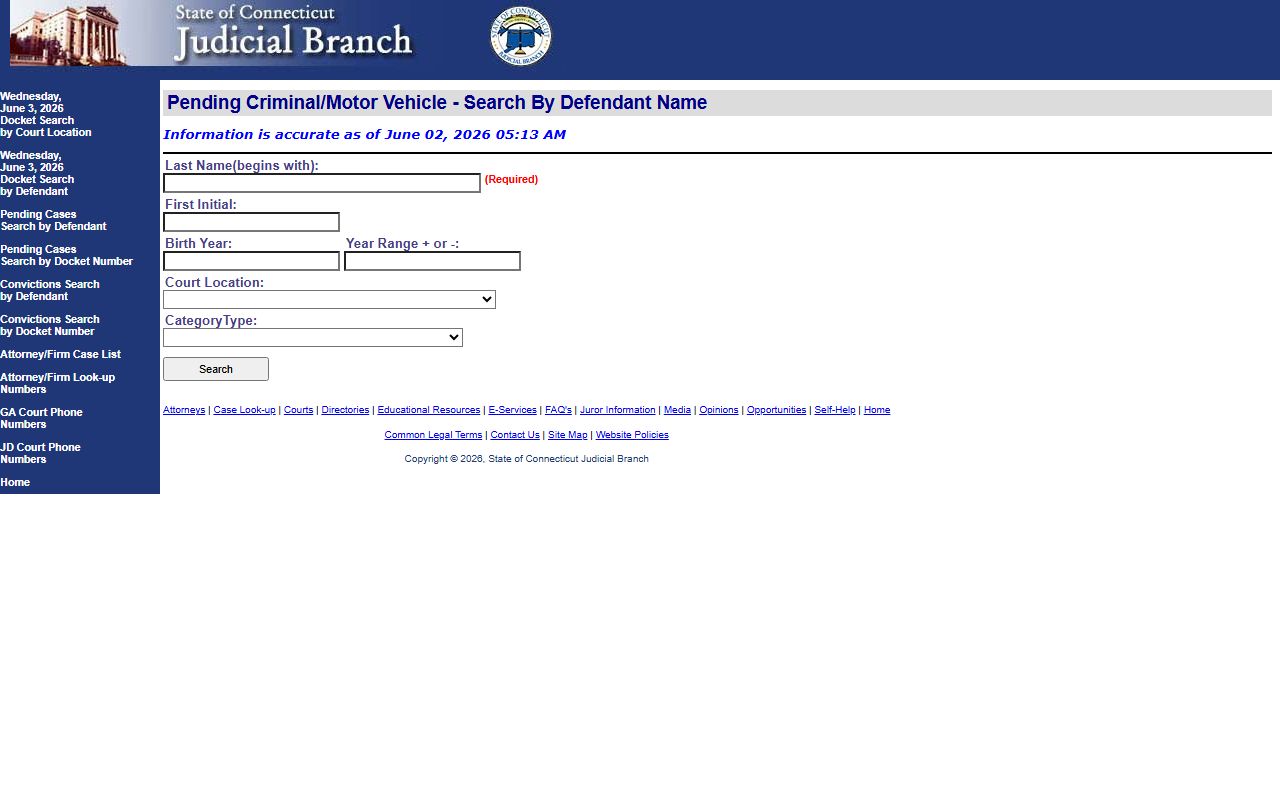
The same name fields and Danbury court-location filter carry across the other criminal lookups, so once you learn one form the rest read the same way.
Court Record Search Fields for a Danbury Case
Both the pending search and the conviction search by defendant use the same core set of fields. Only the last name is required. The other fields just narrow the result so you do not wade through every match in the state. The table below lists the fields the research captured from the conviction search form, which mirrors the pending form.
| Field | Type | Required | Notes |
|---|---|---|---|
| Last Name (begins with) | text | Yes | Up to 60 characters; the required label shows in red. |
| First Initial | text | No | One character. |
| Birth Year | text | No | Four digits. |
| Year Range + or - | text | No | Widens or tightens the birth-year match. |
| Court Location | dropdown | No | Includes "Danbury Geographical Area 3 and Judicial District." |
| CategoryType | dropdown | No | Blank, Criminal, or Motor Vehicle. |
The conviction search is the tool for a case that has already ended in a finding. It is the place to check what an old Danbury arrest became. The conviction search by defendant page uses the field set shown above.
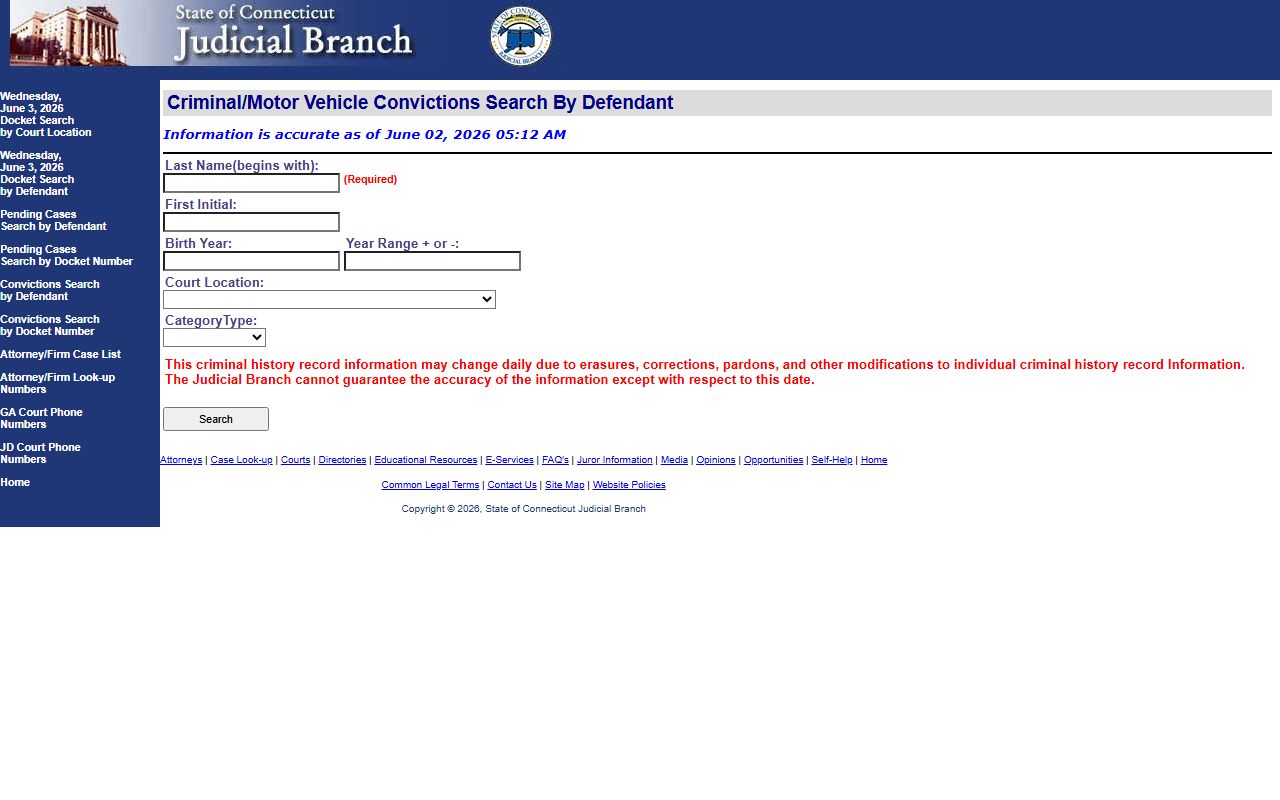
Convictions show online for no more than 10 years after sentencing, and a shorter window can apply, so an older Danbury case may no longer appear even though the record still exists at the court.
How a Danbury Case Opens and What the Record Shows
After the police book a person, the charge record begins when the state's attorney files the case and the matter reaches the court. Connecticut does not document a county grand-jury indictment process for ordinary cases, so the case opens through the prosecutor's review rather than through a charging document signed by a grand jury. The court record that follows is the live picture of the case.
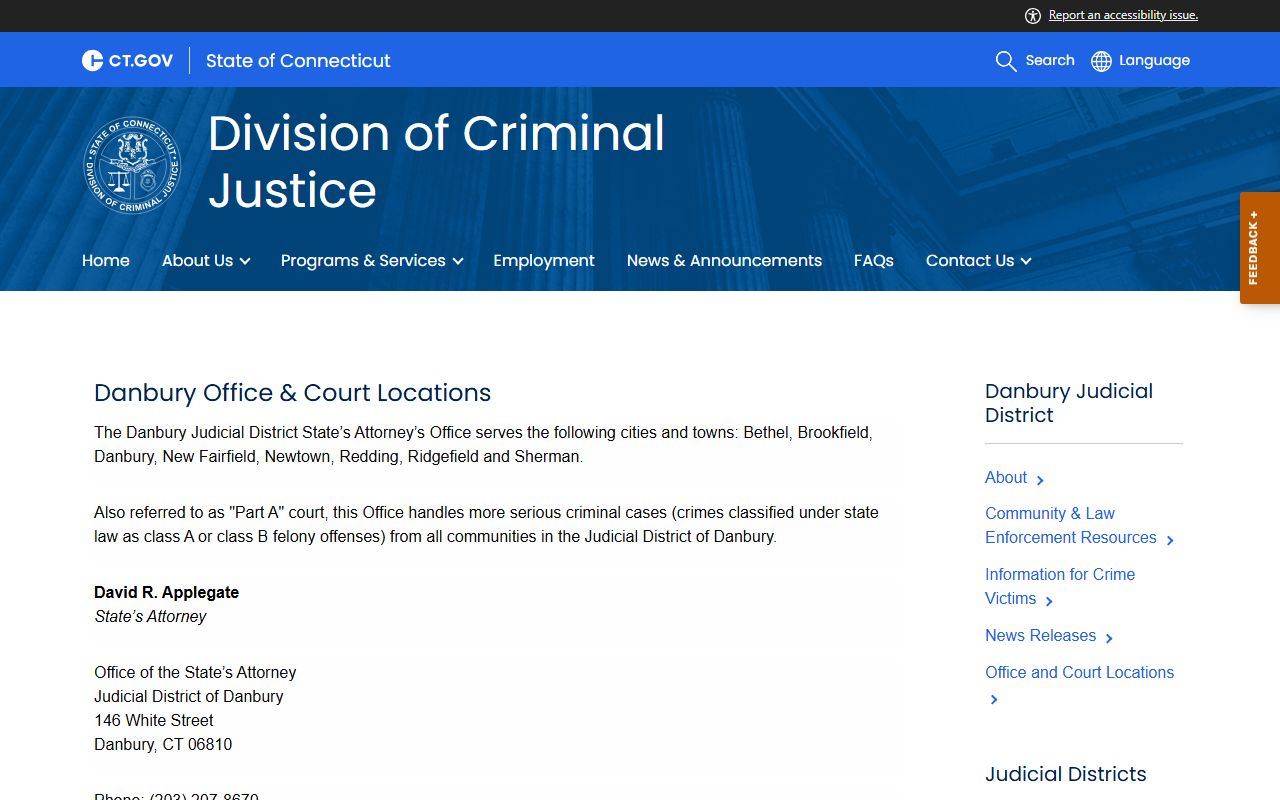
What that record shows depends on the search you run, but the open-case file generally lists the defendant name, the docket number, the court location, the charges, the bail, and the scheduled court dates. The conviction record lists how the case ended. The booking charges that the police logged at arrest are not always the charges the prosecutor finally files. The state's attorney can add, drop, or change counts. That is why the court record, not the arrest log, is the place to confirm the real charges. The Danbury prosecutor's role and contacts are described on the Division of Criminal Justice Danbury page.
The state's attorney office sits in the same White Street building as the court, which keeps the prosecution and the case file in one place. The Danbury Judicial District State's Attorney page lays out the Part A and Part B split.
Juvenile matters do not stay in Danbury. Those route to the juvenile court in Bridgeport, so a young person's case will not appear in the adult Danbury court lookup.
Charge Status in a Danbury Court Record
Charges change as a case moves. The prosecutor may amend a count, reduce it, add one, or drop it. A judge may dismiss it. The status field on the court record tells you where each charge stands right now. Booking charges on the arrest side can read differently from the charges the court finally lists, so always trust the court status over the arrest log. The terms below use Connecticut court language.
| Status | What It Means |
|---|---|
| Pending | The case is open and moving through court; no final result yet. |
| Amended / Reduced | The prosecutor changed a charge, often to a lower count, while the case stays open. |
| Dismissed | The court dropped the charge; the matter ends without a conviction on that count. |
| Nolle Prosequi | The prosecutor declines to go forward for now, subject to Connecticut rules; the charge is not pursued. |
A nolle, short for nolle prosequi, is not the same as a dismissal or a not-guilty finding. It means the state's attorney has chosen not to push the charge ahead at this time. Under Connecticut practice a nolle can clear from the record after a set period. Online case data also reflects entries finished by the close of business the prior day, so a same-day change in Danbury may not show yet.
Bail and Release After a Danbury Arrest
Bail is the money or set of conditions used to help make sure an arrested person comes back to court. In Connecticut, bail can be set by police, by Pretrial Services staff, or by a judge, depending on the timing and the stage of the case. Bail can be posted at a police department, at the courthouse, or at the corrections facility where the person is held. The Danbury court lists Bail Services at 203-207-8715 for case-specific questions.
| Bond Type | How It Works |
|---|---|
| Full cash bail | The full amount is posted in cash; return depends on the case outcome and compliance. |
| 10 percent cash option | Available automatically for bail of $20,000 or less since January 1, 2020, unless a judge orders otherwise. |
| Licensed bondsperson | A licensed bondsperson posts the bail for a non-refundable fee. |
| Hold / detainer | A hold from another agency, such as ICE or a court, can keep a person in custody even after bail is posted. |
Cash or 10 percent cash bail is returned when a diversionary program is granted, the person is acquitted, the complaint or information is dismissed, or the person is sentenced. The release criteria a judge weighs come from C.G.S. Sec. 54-63b. They include the nature of the offense, prior convictions, the record of court appearances, family ties, employment, financial resources, character, mental condition, and community ties. The full set of rules sits on the Judicial Branch bail FAQ.
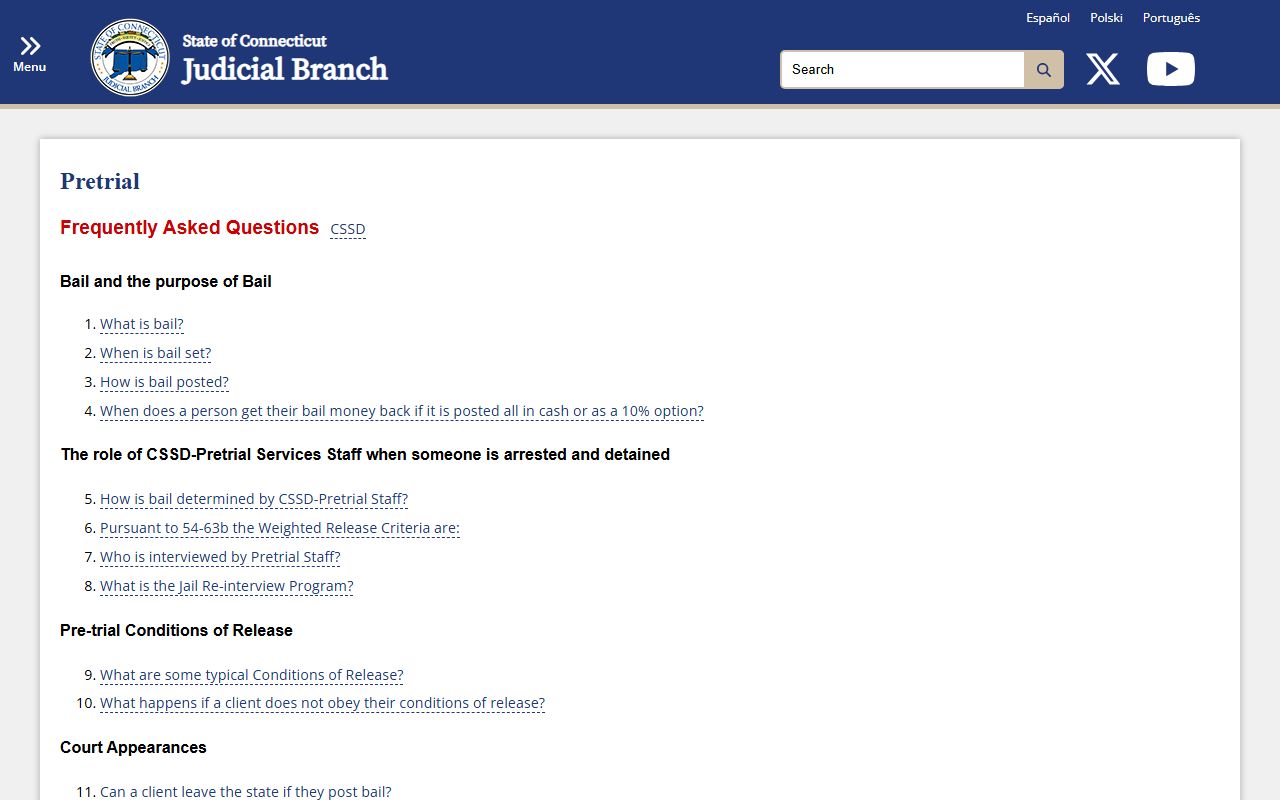
The bail FAQ also explains who can set and post bail at each stage of a case. The Judicial Branch bail FAQ is the official reference for the 10 percent option and the posting locations.
Note: a Danbury Police arrest may still be at police processing while a person already in state custody could be held at Bridgeport or Garner, so confirm the stage before trying to post bail.
Warrants That Lead to a Danbury Arrest
An open warrant can turn into a booking at any time. Danbury Police do not publish a city warrant list, but the Connecticut Judicial Branch runs a statewide warrant search for certain court warrant types. It covers arrest warrants for violation of probation, failure to appear, and orders to incarcerate. A violation of probation means a person broke a rule of court-ordered supervision. A failure to appear means a person missed a required court date. The search does not include every warrant type, and some are held back for safety or because they came from a youthful offender case.
To check, use the Judicial Branch warrant search and filter by the Danbury town or the Danbury court when those options fit. The form asks for at least the first two letters of the last name, and it accepts a town, a court location, a first name, a birth year, and a year range to narrow the match. The page is informational only. It warns users not to act on the result alone. For a Danbury case, you can also search the pending criminal lookup and call the GA 3 clerk at 203-207-8600. Bench warrants and sealed or youthful offender warrants may not appear online, so confirm with the court or counsel.
The warrant search covers only the three court warrant types it names, which is a key limit to keep in mind. The violation-of-probation and failure-to-appear search shows the fields and the Danbury filter options.
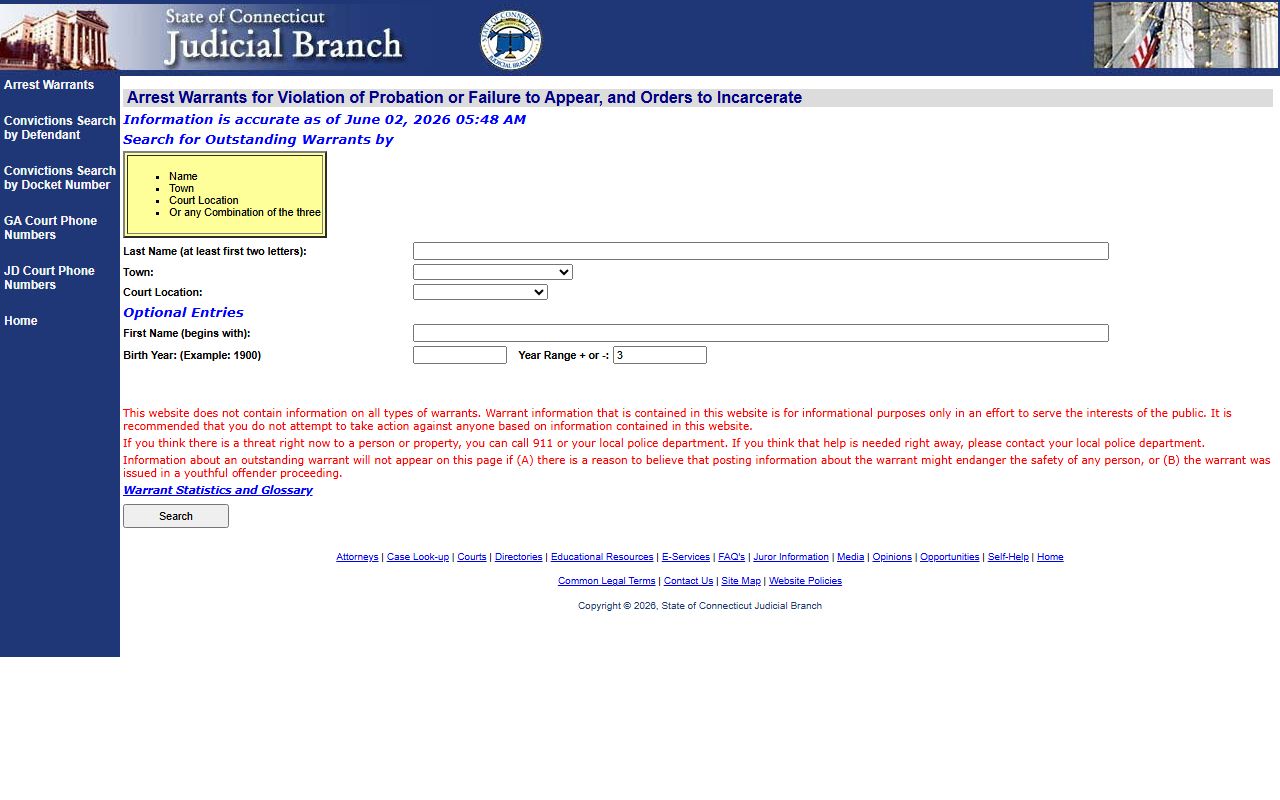
Because the tool leaves out many warrant categories, a clear search result does not prove a person has no warrant at all.
Charges vs. Convictions in Court Records
Being arrested and charged is not the same as being convicted. A charge is an accusation. A conviction is the result. The court record after an arrest can sit at the charge stage for a long time before it ever reaches a finding, and many charges never become convictions at all. Reading a record well means telling the two stages apart.
| Charge | Conviction | |
|---|---|---|
| Stage | Accusation | Verdict or plea |
| Burden of Proof | Probable cause | Beyond a reasonable doubt |
| Where it shows | Pending case search | Conviction search |
The online tools split along this same line. The pending search holds open charges. The conviction search holds finished cases that ended in a conviction. A case that was dismissed or ended in a not-guilty finding will not read as a conviction. That difference matters a great deal when someone reviews a Danbury court record to judge what actually happened.
Connecticut Erasure vs. Sealed Records
Connecticut does not use the word "expungement" the way many other states do. It uses "erasure." When a case is dismissed, ends in a not-guilty finding, or otherwise qualifies, C.G.S. Sec. 54-142a can erase the record. Erasure reaches the police, court, and state's attorney records tied to the matter. So the closest match to what other states call sealing or expungement is Connecticut's erasure system.
| Connecticut Erasure (54-142a) | Sealing (other states' term) | |
|---|---|---|
| Effect | Eligible records erased from public access | Record hidden from public view but kept |
| Reaches | Police, court, and state's attorney records | Varies by state |
| Common trigger | Dismissal, not-guilty finding, eligible disposition | Varies by state |
Once a Danbury case is erased, the online court lookup should no longer show it, and a records request to the court will not pull it. This is why a dismissed charge can drop out of view. The erasure chapter and its terms sit in the Connecticut General Statutes at the criminal-record erasure chapter.
Written Danbury Court Record Searches
Not every search runs online. The online lookup is a public service, and the Judicial Branch is clear that it is not the official court record. Users are responsible for checking what they find against the official case file held at the court. For a formal written record search, the request goes to the geographical area court where the arrest happened. For a Danbury-area arrest, that is usually GA 3 at Danbury unless the case moved.
A written request should include the person's name, date of birth, and, if you have it, the arrest date or the disposition date. Searches are limited to the records held at the court location that receives the request. Copy fees apply. Court records and documents run $1.00 per page, and administrative records run $0.25 per page. The fee and request details are on the Judicial Branch court-record FAQ. The general disclaimer about what the online lookup does and does not show sits on the Judicial Branch case lookup disclaimer.
Note: youthful offender, juvenile, infraction, and violation convictions are not shown the same way online, so a clean online result does not always mean a clean record.
Court Notifications and Clerk Verification
Watching a Danbury court record over time is easier with alerts. Connecticut runs a free notification service through CT SAVIN and VINELink. It can send updates on case events. The brochure lists alerts for hearings, bail changes, a failure to appear, plea hearings, disposition, and custody events. You can register with a first and last name, an inmate number, or a docket number. Sign up at the Connecticut VINELink page or call the CT SAVIN line.
When the online display is missing, out of date, sealed, or simply does not match what you expect, the clerk is the next stop. Call the Danbury Chief Clerk at 203-207-8600. The clerk's office holds the official record and can confirm what the public lookup cannot. Because online case data reflects entries finished by the prior business day, the clerk is the right check for any same-day change in a Danbury case.
Background Checks and Court Records
The Judicial Branch case lookup is built for public reference, not for screening. The site itself says it should not stand in for a criminal background check. A formal check that an employer or landlord can rely on runs through the proper State Police and Judicial Branch criminal-history channels, which follow federal rules. A casual look at a court record after an arrest does not meet that bar.
Important: Danbury County Inmate Population is not a consumer reporting agency under the FCRA, and nothing here may be used for employment, credit, tenant, or insurance decisions.
Restricted Danbury Court Records After Arrest
Some court records after an arrest stay out of public view. Juvenile cases route to Bridgeport and do not show in the adult Danbury lookup. Erased records under Sec. 54-142a drop from public access. Youthful offender matters, sealed charges, and certain dismissed charges are withheld. Connecticut FOIA treats a record of arrest as public under Sec. 1-215, but that is subject to exceptions, redactions, and pending-prosecution limits. The arrest-record provisions sit in the Connecticut FOIA chapter at the current public-records chapter and the broader provision at the general FOIA chapter.
The takeaway is simple. A missing record does not always mean a missing case. The matter could be erased, sealed, juvenile, or held back during an open prosecution. When the court lookup comes up empty and you expected a result, the clerk and a written records request are the right next steps. For the custody and booking side of the same arrest, the jail inmate records page covers the roster and the state locators.